

What Is The Makeup Of Students At Community College

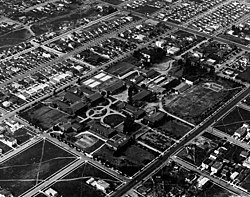
A customs higher is a type of educational institution. The term can accept different meanings in different countries: many customs colleges have an "open up enrollment" for students who take graduated from high school (also known equally senior secondary schoolhouse or upper secondary school). The term commonly refers to a higher educational institution that provides workforce education and college transfer academic programs. Some institutions maintain able-bodied teams and dormitories like to their university counterparts.
Commonwealth of australia [edit]
In Commonwealth of australia, the term "community college" refers to small private businesses running brusque (e.m. 6 weeks) courses mostly of a self-improvement or hobbyist nature. Equivalent to the American notion of community colleges are Tertiary and Further Education colleges or TAFEs; these are institutions regulated mostly at land and territory level. There are also an increasing number of private providers colloquially called "colleges".
TAFEs and other providers carry on the tradition of adult education, which was established in Australia around the mid-19th century, when evening classes were held to help adults enhance their numeracy and literacy skills.[i] Most Australian universities tin likewise be traced back to such forerunners, although obtaining a university charter has ever changed their nature. In TAFEs and colleges today, courses are designed for personal development of an individual or for employment outcomes. Educational programs comprehend a variety of topics such as arts, languages, business concern and lifestyle. They commonly are scheduled to run two, iii or four days of the calendar week, depending on the level of the grade undertaken. A Certificate I may only run for iv hours twice a week for a term of 9 weeks. A total-time Diploma course might have classes 4 days per week for a yr (36 weeks). Some courses may exist offered in the evenings or weekends to conform people working full-fourth dimension. Funding for colleges may come from government grants and course fees. Many are not-for-profit organisations. Such TAFES are located in metropolitan, regional and rural locations of Australia.
Education offered by TAFEs and colleges has inverse over the years. By the 1980s, many colleges had recognised a customs need for calculator preparation. Since then thousands of people have increased skills through It courses. The bulk of colleges past the late 20th century had likewise get Registered Training Organisations. They offering individuals a nurturing, non-traditional education venue to proceeds skills that better fix them for the workplace and potential job openings.[2] TAFEs and colleges have not traditionally offered available'south degrees, instead providing pathway arrangements with universities to continue towards degrees. The American innovation of the associate degree is being developed at some institutions. Certificate courses I to IV, diplomas and avant-garde diplomas are typically offered, the latter accounted equivalent to an undergraduate qualification, albeit typically in more vocational areas. Recently, some TAFE institutes (and individual providers) accept also become higher education providers in their own right and are now starting to offering available'due south degree programs.
Canada [edit]
In Canada, colleges are developed educational institutions that provide college education and tertiary didactics, and grant certificates and diplomas. Alternatively, Canadian colleges are often called "institutes" or "polytechnic institutes". Besides, in Ontario, the 24 colleges of applied arts and technology have been mandated to offer their own stand-lonely degrees also as to offer joint degrees with universities through "articulation agreements" that oft effect in students emerging with both a diploma and a degree. Thus, for example, the University of Guelph "twins" with Humber Higher and York University does the same with Seneca Higher. More recently, however, colleges accept been offering a variety of their own degrees, often in business, engineering science, science, and other technical fields. Each province has its own educational organization, as prescribed by the Canadian federalism model of governance. In the mid-1960s and early 1970s, most Canadian colleges began to provide practical instruction and training for the emerging and booming generation, and for immigrants from around the world who were inbound Canada in increasing numbers at that time. A formative trend was the merging of the then separate vocational training and developed instruction (night school) institutions.
Canadian colleges are either publicly funded or private post-secondary institutions (run for turn a profit).
In terms of academic pathways, Canadian colleges and universities collaborate with each other with the purpose of providing college students the opportunity to academically upgrade their education. Students can transfer their diplomas and earn transfer credits through their completed college credits towards undergraduate university degrees.
The term associate degree is used in western Canada to refer to a two-year college arts or science degree, like to how the term is used in the United States. In other parts of Canada, the term advanced caste is used to indicate a 3- or 4-year college program.
In Quebec, three years is the norm for a university degree because a yr of credit is earned in the CÉGEP (higher) system. Even when speaking in English language, people frequently refer to all colleges as[3] Cégeps; however, the term is an acronym more correctly applied specifically to the French-language public organization: Collège d'enseignement général et professionnel (CEGEP); in English language: Higher of General and Vocational Education. The discussion "higher" can too refer to a private high school in Quebec.
- Canadian community college systems
- Listing of colleges in Canada
- Colleges and Institutes Canada (CICan)[4] – publicly funded educational institutions; formerly the Clan of Canadian Community Colleges (ACCC)
- National Association of Career Colleges[five] – privately funded educational institutions; formerly the Association of Canadian Career Colleges
Bharat [edit]
In India, 98 customs colleges are recognized past the University Grants Committee. The courses offered by these colleges are diplomas, advance diplomas and certificate courses. The duration of these courses commonly ranges from six months to two years.[half dozen]
Malaysia [edit]

Community colleges in Malaysia are a network of educational institutions whereby vocational and technical skills training could be provided at all levels for school leavers before they entered the workforce. The community colleges also provide an infrastructure for rural communities to gain skills grooming through short courses likewise as providing access to a post-secondary education.
At the moment, nearly community colleges laurels qualifications up to Level 3 in the Malaysian Qualifications Framework (Certificate iii) in both the Skills sector (Sijil Kemahiran Malaysia or the Malaysian Skills Document) likewise as the Vocational and Training sector but the number of community colleges that are starting to award Level 4 qualifications (Diploma) are increasing. This is 2 levels below a available'south caste (Level 6 in the MQF) and students within the system who intend to further their studies to that level volition normally seek entry into Advanced Diploma programs in public universities, polytechnics or accredited private providers.
Philippines [edit]
In the Philippines, a community school functions every bit uncomplicated or secondary schoolhouse at daytime and towards the terminate of the day convert into a community college. This type of institution offers night classes under the supervision of the same principal, and the aforementioned faculty members who are given part-time college didactics load.[7]
The concept of community college dates dorsum to the time of the old Minister of Pedagogy, Culture and Sports (MECS) that had under its wings the Bureaus of Elementary Education, Secondary Pedagogy, Higher Education and Vocational-Technical Education. MECS Secretary, Dr. Cecilio Putong, who in 1971 wrote that a community school is a school established in the community, by the customs, and for the community itself. Dr. Pedro T. Orata of Pangasinan shared the same idea, hence the establishment of a customs college, now called the City College of Urdaneta.[7]
A community college like the one in Abuyog, Leyte can operate with merely a PHP 124,000 annual upkeep in a ii-story structure housing more than than 700 students.[vii]
Great britain [edit]
Except for Scotland, this term is rarely used in the United kingdom of great britain and northern ireland. When information technology is, a community college is a schoolhouse which not only provides education for the schoolhouse-age population (11–18) of the locality, simply besides additional services and education to adults and other members of the community.[8] This education includes but is non limited to sports, adult literacy and lifestyle education. Usually when students finish their secondary schoolhouse studies at age 16, they move on to a sixth course higher where they study for their A-levels (although some secondary schools have integrated sixth forms). After the ii-yr A-level period, they may proceed to a college of further teaching or a university. The former is also known as a technical college.
United States [edit]
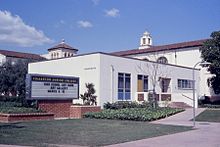
Fullerton College, the oldest community college (originally "junior college") in continuous operation in California, established in 1913


In the United states, community colleges, sometimes called junior colleges, technical colleges, ii-yr colleges, or city colleges, are primarily public institutions providing tertiary instruction, also known as standing education, that focuses on certificates, diplomas, and associate degrees. After graduating from a community college, some students transfer to a liberal arts college or university for two to three years to complete a bachelor'due south degree.
Earlier the 1970s, community colleges in the United states of america were more than ordinarily referred to as junior colleges. That term is still used at some institutions. Public community colleges primarily concenter and accept students from the local community and are ordinarily supported by local tax revenue. They usually work with local and regional businesses to ensure students are beingness prepared for the local workforce.
Research [edit]
Some research organizations and publications focus upon the activities of community college, junior college, and technical college institutions.[9] Many of these institutions and organizations present the near current research and practical outcomes at almanac community college conferences.
- The American Clan of Community Colleges[10] [11] has provided oversight on community college research since the 1920s.[12] AACC publishes a research journal called the Community Higher Periodical.[xiii]
- The Community College Research Center (CCRC) at Teachers College, Columbia Academy, has been conducting enquiry on community colleges since 1996 to place barriers to students' post-secondary access and promising solutions. CCRC's publishes research reports, briefs, and resources geared toward a multifariousness of community college stakeholders, including college and college arrangement leaders, faculty and support staff, policymakers, and institutional researchers.
- The Association of Community College Trustees (ACCT) has provided education for customs college boards of directors and advocacy for customs colleges since 1972. ACCT President and CEO J. Noah Chocolate-brown published a book almost the past, nowadays, and hereafter of community colleges, Charting a New Course for Community Colleges: Aligning Policies with Practice.
- The Middle for Community Higher Educatee Engagement at the University of Texas at Austin administers surveys and provides data assay back up to member colleges regarding various factors of student engagement and involvement in customs colleges in the Us and Canada.[14]
- The Office of Community College Research and Leadership at the Academy of Illinois at Urbana–Champaign studies policies, programs, and practices designed to enhance outcomes for diverse youth and adults who seek to transition to and through college to employment. OCCRL'southward research spans the P-twenty education continuum, with an intense focus on how community colleges affect didactics and employment outcomes for various learners. Results of OCCRL'south studies of pathways and programs of report, extending from high school to customs colleges and universities and to employment, are disseminated nationally and internationally. Reports and materials are derived from new cognition captured and disseminated through OCCRL's website, scholarly publications, and other vehicles.[15]
Several peer-reviewed journals extensively publish research on customs colleges:
- Customs College Journal of Research and Practice
- Community College Review
- The College Quarterly [sixteen]
- Periodical of Applied Enquiry in the Community College
- Journal of Transformative Leadership and Policy Studies
- New Directions for Community Colleges
Come across as well [edit]
- Articulation (education)
- Distance learning
- E-learning
- Folk high school
- Junior college
- Lifelong learning
- In Australia
- Technical and further education
- Workers' Educational Clan, also in the U.k.
- In the Philippines
- Association of Local Colleges and Universities
- Local college and university
- In the Great britain
- Further teaching
References [edit]
- ^ just host. "Welcome ace.nsw.gov.au - Justhost.com".
- ^ cca.edu.au Archived 2011-03-02 at the Wayback Machine
- ^ "Clearing, Diversité et Inclusion Québec - Working in Québec". Quebec Government . Retrieved 11 June 2014.
- ^ "Perioperative Nursing/LPN - Colleges and Institutes Canada".
- ^ "NACC – National Association of Career Colleges".
- ^ "UGC approves 98 community colleges from five states". Retrieved 13 June 2015.
- ^ a b c Danao, Dr. Carolina P. (2005-02-twenty). "The medium-term higher instruction development programme and the local colleges and universities". The Manila Bulletin Online. Retrieved 2008-08-19 .
- ^ "customs college meaning in the Cambridge English Dictionary".
- ^ Mellow, G.O. & Heelan, C. (2008). Minding the Dream: The Process and Practice of the American Community College. New York: Rowman & Littlefield. ISBN 978-0-7425-6292-9
- ^ Cohen, A.Chiliad. & Brawer, F.B. (2008). The American Community College (5th Ed.). San Francisco: Jossey-Bass. ISBN 978-0-470-17468-v
- ^ Vaughn, G.B. (2000). The Community College Story. Community College Press. ISBN 0-87117-323-9
- ^ Geller, H.A. (2001). "A brief history of community colleges and a personal view of some bug (open admissions, occupational training and leadership)." http://www.eric.ed.gov/ERICWebPortal/contentdelivery/servlet/ERICServlet?accno=ED459881
- ^ gseis.ucla.edu Archived 2009-04-05 at the Wayback Motorcar
- ^ "CCSSE – Community College Survey of Student Engagement". Retrieved 13 June 2015.
- ^ "Office of Community College Research and Leadership, University of Illinois at Urbana-Champaign". Retrieved 13 June 2015.
- ^ The College Quarterly
Farther reading [edit]
- Baker, G. A. III (1994). A handbook on the community higher in America: Its history, mission, and management. Westport, CT: Greenwood Press.
- Cohen, A.M., Brawer, F.B. (2003) The American Community Higher, fourth edition. San Francisco: Jossey Bass.
- Dougherty, K. J. (1994). The contradictory college: The conflicting origins, impacts, and futures of the community college. Albany, NY: State Academy of New York Press.
- Frye, J. H. (1992). The vision of the public inferior college, 1900–1940. Westport, CT: Greenwood Printing.
- Kasper, H.T. (2002). The changing role of community college. Occupational Outlook Quarterly, 46(4), 14–21.
Source: https://en.wikipedia.org/wiki/Community_college
Posted by: warnerwujjok.blogspot.com
0 Response to "What Is The Makeup Of Students At Community College"
Post a Comment